Search "flow state" and you get the same article a hundred times: a McKinsey statistic about 500% productivity, a Csikszentmihalyi quote about challenge-skill balance, and the implication that you can hack your brain into peak performance with the right routine. Most of this is half-true. Some of it is wrong. Almost none of it engages with what neuroscience can and can't say about flow as a brain state.
We're a company called FlowState, so we have a vested interest in this concept. We also have a vested interest in being honest about it. The people building serious tools in this space need to separate the parts that hold up from the parts that don't.
What Csikszentmihalyi actually proposed
The concept comes from Mihaly Csikszentmihalyi, a psychologist who started studying it in the 1970s after noticing that artists would lose themselves in their work for hours, forgetting to eat or sleep. He interviewed athletes, chess masters, rock climbers, surgeons, and composers, and the people across these very different activities described their best moments in remarkably similar terms. They felt carried by the activity. They lost track of time. They were fully absorbed.
In Flow: The Psychology of Optimal Experience (1990), Csikszentmihalyi formalized the concept around nine components: balance between challenge and skill, clear goals, immediate feedback, complete concentration, a sense of control, loss of self-consciousness, distortion of time, action and awareness merging, and the activity being intrinsically rewarding.
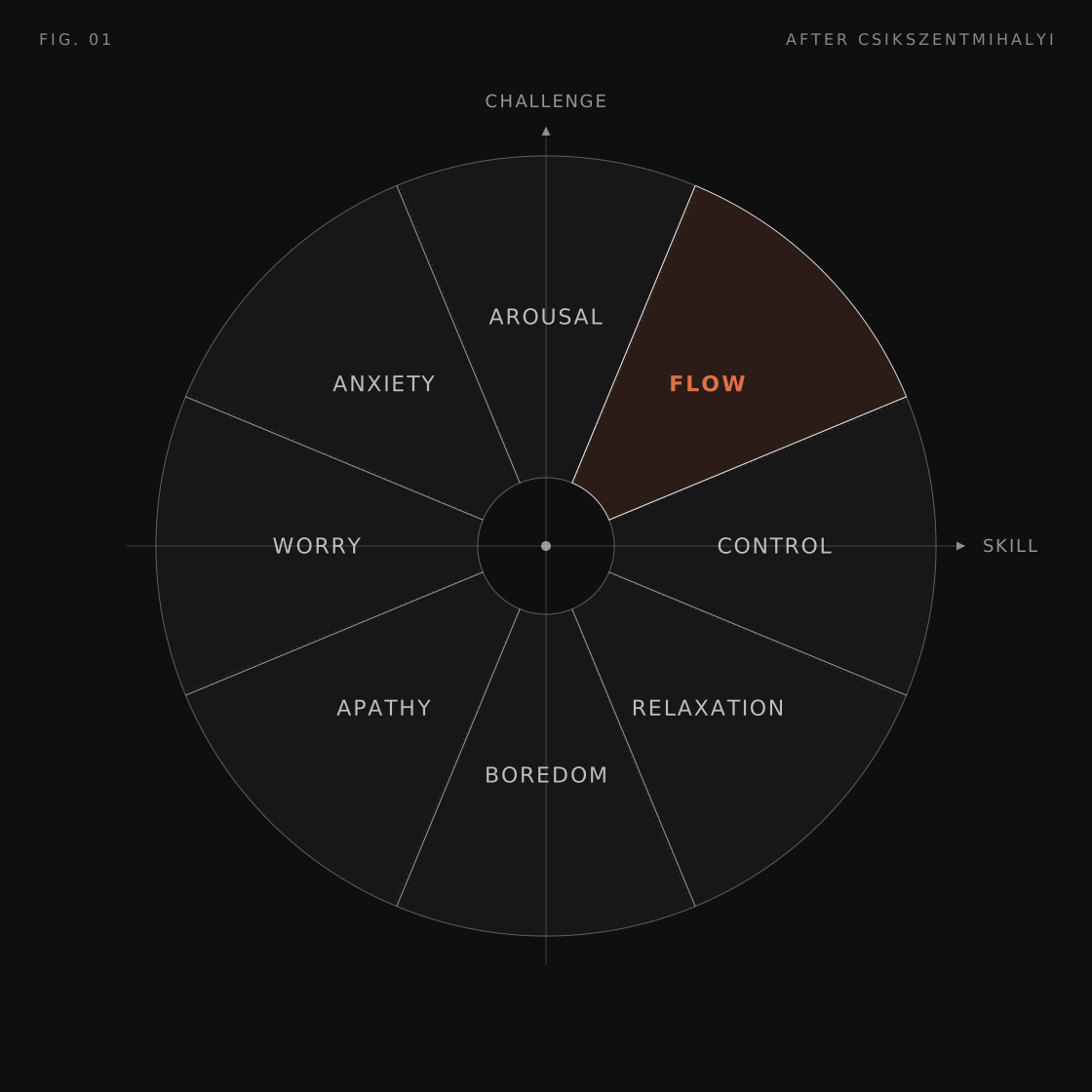
Two things matter about this. First, the original definition is phenomenological. Flow is defined by what the experience feels like from the inside, not by a brain measurement. Second, the central condition is the challenge-skill balance. Tasks that are too easy produce boredom. Tasks too hard produce anxiety. The narrow zone where your skill is genuinely matched to a real challenge is where flow tends to show up. That part has held up well across decades of research.
The neuroscience part is messier.
What neuroscience has tried to measure
The most influential neural theory came from Arne Dietrich in 2003. Working from observations about runner's high, meditation, and other altered states, Dietrich proposed transient hypofrontality: flow involves a temporary downregulation of the prefrontal cortex. The prefrontal cortex handles analytical thinking, self-monitoring, and planning. Turn it down, the theory goes, and you lose self-consciousness, your sense of time goes weird, and well-practiced skills can run without interference from the part of you that second-guesses everything.
The clearest supporting evidence came in 2008, when Charles Limb and Allen Braun at NIH put six jazz pianists in an fMRI scanner and asked them to improvise. They observed extensive deactivation of prefrontal regions and increased activity in sensorimotor areas during improvisation compared to playing memorized scales. That fits the hypofrontality story.
Other studies have implicated the dorsolateral prefrontal cortex, the putamen (a basal ganglia structure involved in skill execution), the default mode network (the system that tracks self-referential thinking), and reward circuits. A 2024 framework paper in Communications Psychology summarized the emerging consensus: flow involves increased activity in attentional and reward networks alongside reduced activity in self-monitoring networks.
That's the part the science can say with reasonable confidence.
The part the science can't say
A 2022 systematic review in Cortex examined 25 neuroimaging studies of flow and concluded that the findings were "too divided to reach a conclusion." The 2024 Communications Psychology paper spent most of its length cataloging methodological problems and proposing a 24-item checklist for future studies, which is not what you publish if the field has settled answers.
The core problem is the gap between where flow happens and where it gets studied. Csikszentmihalyi's original observations came from expert performance during self-selected, intrinsically motivating activities like jazz, rock climbing, and surgery. Lab studies use constrained tasks: mental arithmetic, video games engineered to balance challenge and skill, simple motor sequences. They ask undergraduates to complete these in a scanner. Whether the brain state observed in those conditions is the same brain state Csikszentmihalyi described in expert jazz improvisation is genuinely unclear.
Transient hypofrontality has critics on its own merits. Complex creative work requires prefrontal involvement, since you're evaluating ideas, choosing between options, and revising as you go. A wholesale prefrontal shutdown would make most flow-eliciting activities impossible. Some researchers (Weber and Tamborini, among others) have proposed alternative theories built around neural synchronization across networks rather than wholesale deactivation. The more careful version of hypofrontality is probably that certain prefrontal subregions downregulate while others stay active, and which ones depend on the task. Harder to summarize on a TED stage. Probably closer to what's actually happening.
The 500% claim
Most productivity articles about flow eventually cite a McKinsey finding that executives report being five times more productive in flow. The number comes from Cranston and Keller's 2013 piece in McKinsey Quarterly, which surveyed about 5,000 executives about their flow experiences at work.
Read that sentence carefully. The methodology was a survey, and the data was self-report. Executives described a state they liked and estimated how productive they thought they were while in it. There is no controlled measurement of output, no comparison condition, no objective metric. The 500% number is what people who enjoyed flow said they thought their productivity was when in flow.
That isn't nothing. Self-report data has a place, especially for subjective experience. But it isn't a controlled study of cognitive performance, and the way the number gets cited treats it as if it were.
What we know with reasonable confidence
Flow is a real phenomenological experience that people describe consistently across cultures and activities. It's most likely to occur when a person with sufficient skill engages a task that's genuinely challenging and gives clear feedback. Brain imaging shows that this kind of engagement involves attentional and reward networks ramping up while parts of the self-monitoring system ramp down. People in flow tend to perform better than people who aren't, though the magnitude is not the five-times figure marketing implies.
What we don't know yet: whether "flow" is one neural state or several similar ones, what the precise EEG or fMRI signature is, whether you can reliably induce it from outside, whether interventions that produce flow-like brain states actually produce flow-like performance gains, and how laboratory flow relates to the expert-performance flow Csikszentmihalyi originally studied.
A note on what we're building
At FlowState we're working on closed-loop EEG that measures focus state in real time. The reason we use the name: focused attention with reduced self-monitoring is one of flow's clearest phenomenological signatures, and it's the part neuroscience has the strongest grip on. We don't claim to deliver flow on demand. The actual claim is narrower. Real-time measurement of attentional state is more useful than products that play scheduled audio and hope.
Flow is one of those concepts where the honest version is more interesting than the marketing version. It's a real experience that's increasingly understood as a real neural pattern. The productivity-culture version that promises five-times-faster work and peak performance you can summon with the right routine is, as best we can tell, oversold. It's useful as a target, but it isn't yet a delivery mechanism.
References
Alameda, C., Sanabria, D., & Ciria, L. F. (2022). The brain in flow: A systematic review on the neural basis of the flow state. Cortex, 154, 348–364. https://doi.org/10.1016/j.cortex.2022.06.005
Cranston, S., & Keller, S. (2013). Increasing the meaning quotient of work. McKinsey Quarterly, 1, 48–59.
Csikszentmihalyi, M. (1990). Flow: The Psychology of Optimal Experience. Harper & Row.
Dietrich, A. (2003). Functional neuroanatomy of altered states of consciousness: The transient hypofrontality hypothesis. Consciousness and Cognition, 12(2), 231–256. https://doi.org/10.1016/S1053-8100(02)00046-6
Dietrich, A. (2004). Neurocognitive mechanisms underlying the experience of flow. Consciousness and Cognition, 13(4), 746–761. https://doi.org/10.1016/j.concog.2004.07.002
Durcan, O., Holland, P., & Bhattacharya, J. (2024). A framework for neurophysiological experiments on flow states. Communications Psychology, 2, 66. https://doi.org/10.1038/s44271-024-00115-3
Limb, C. J., & Braun, A. R. (2008). Neural Substrates of Spontaneous Musical Performance: An fMRI Study of Jazz Improvisation. PLoS ONE, 3(2), e1679. https://doi.org/10.1371/journal.pone.0001679